
Travel Planning
Re-imagined
Background
.png)
Project Duration: June - September 2023
According to research, it takes the equivalent of four working days (30 hours) to plan trips. Adventura was an idea born out of a tiresome process of planning a month-long trip around Europe. After hours of research and frustration, the creator knew there had to be an easier and more efficient way to plan trips.
The result of this project is a cutting-edge travel planning management platform designed to transform the way users plan their trips finding the right vacation at the right price, in the right place using key words, basic information about the traveler and criteria for trips.
Utilizing AI technology, LLM and analytical design, Adventura is the culmination of the three areas of focus for four user pain points: Streamlining the Planning Process, Granting Personalization, Easy Organization, and Tailored Access to Local Insights.
Research
What is the problem and what are our goals?
The Process
What is our process to understand our user base?
Summary
What were our key findings?
The Problem
Planning long, extensive trips takes time, and energy, and is a very tedious process. From first-hand experience, the creator understood how the process could easily be made more efficient utilizing the advances of recent technology-especially AI.
Understanding the User
1. User Research:
-
Conducted surveys & interviews with users
-
Analyzed market trends & competitor apps
-
Studied user behavior & interactions
-
Explored travel forums & online communities
2. Personas:
-
Created distinct travel personas
-
Defined preferences, goals & behaviors
-
Targeted leisure seekers, business travelers, budget-conscious tourists
-
Used personas as reference throughout development
3. Problem Statements:
-
Identified user pain points & challenges
-
Focused on user-centered issues
-
Prioritized based on impact & business goals
4. User Journey Maps:
-
Mapped out entire user journey
-
Identified touchpoints & interactions
-
Highlighted emotions & opportunities
-
Improved app flow & usability
Summary of Findings
Through surveys, interviews, and online community exploration, we gathered data on their travel behaviors and pain points. The target audience showed a strong inclination towards utilizing AI technology to streamline the trip planning and itinerary building processes. They expressed a desire for personalized travel recommendations and seamless itinerary management. The research findings served as a foundation for creating distinct travel personas, which highlighted the specific preferences and goals of leisure seekers, business travelers, and budget-conscious tourists. With this user-centered approach, we aim to deliver an AI-driven travel management platform that caters precisely to the needs of our diverse user segments, ensuring a delightful and efficient travel experience for all.
User Research - Pain Points
1
Overwhelming Planning Process
Many users find the trip planning process time-consuming and overwhelming, with multiple options for flights, accommodations, and activities.
2
Lack of Personalization
Users often struggle to create personalized and optimized itineraries that suit their unique travel style. The product should address this pain point by utilizing AI algorithms to curate tailored itineraries.
3
Difficulty in Information Organization
Users face challenges in organizing all their travel-related information, such as booking details, confirmations, and travel documents.
4
Limited Access to Local Insights
Travelers often miss out on authentic local experiences due to a lack of information about hidden gems and insider tips.
Digital Wireframes
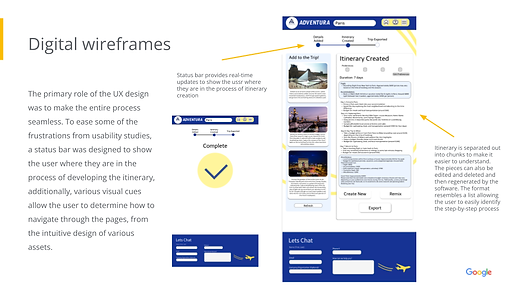
Digital Wireframes form the backbone of the design and research process. Through multiple user studies and intentional design-thinking frameworks, the platform underwent several iterations adding features that addressed many of the above user pain points.
Several concepts such as the chat feature were implemented after user testing and feedback, utilizing the product design process to brainstorm, design, test, collect feedback, and iterate.
.png)
Usability Studies
The Findings
Round 1 Findings
1
Users desired additional customization capabilities
2
Users wanted a more intuitive design to alleviate confusion
3
Users wanted a simple, but clear path to the end goal and assistance along the way
Round 2 Findings
1
AI integration was a valuable addition and increased user conversion rates toward the completion stage
2
Incorporating tutorial aspects and intuitive asset designs allowed users to easily find the next step
3
A more simple and polished design was very appreciated by users and eased confusion in the process
Accessibility Considerations
2
3
1
One accessibility consideration we implemented was making the assets and background of the UI a simplistic soft white color, so that people would be able to distinguish layers and sections. This is in contrast to a dark color where multiple overlapping layers would blend together
2
One more accessibility consideration we implemented was the AI customization request feature. We included a “Chat” where you would be able to type in any specific customization features that you wanted.
3
Finally, within the recommendation tab, we included both pictures and text for every option so that people would be able to have a visual guide building a mental image in what the recommendations were specifically offering.